
GPU mining
Mining
The Mining panel on the GPU Workers page mints a proof-of-work collection from one of your wallets, with the GPU workers you pick doing the hashing.
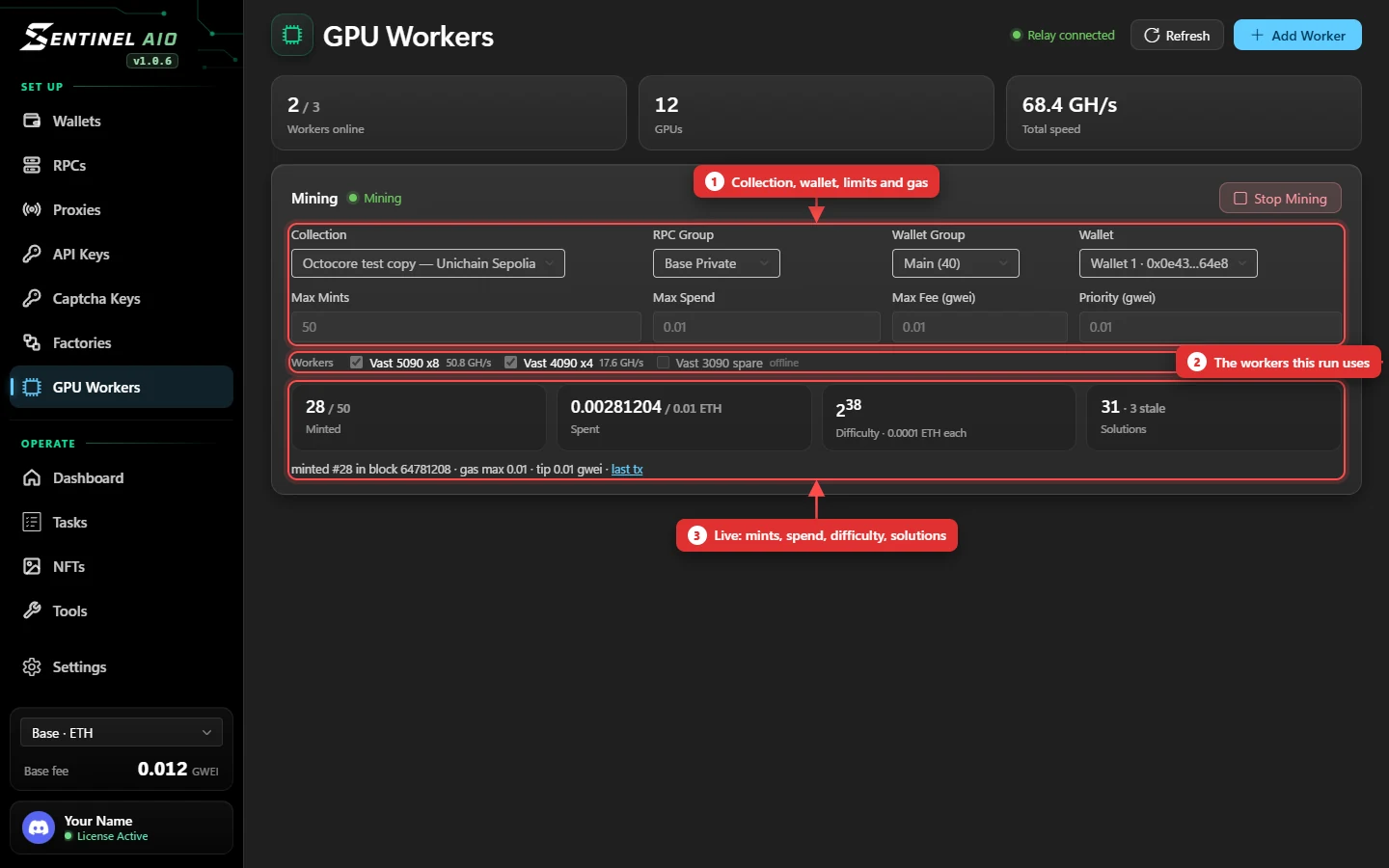
Setting up a run
| Collection | What to mine: the proof-of-work drops the app supports right now. The list changes as drops come and go, with app updates. |
|---|---|
| RPC Group | Your RPCs for the collection's chain. Reads and mints go through them. |
| Wallet | The one wallet that mints, picked from a wallet group. |
| Max Mints | The run stops after this many. |
| Max Spend | Mint price and gas together, in the chain's coin. The run stops before a mint would go past it. |
| Max Fee / Priority | Gas in gwei. Leave them on auto and the app follows the market, checked every 30 seconds. Set Priority alone and the max fee moves with it. |
| Workers | Tick the workers this run uses. Their speeds add up. |
Press Start Mining. Stop Mining ends the run at any time; the workers go idle.
While it runs
| Minted | Mints so far, out of your Max Mints. |
|---|---|
| Spent | Price and gas so far, out of your Max Spend. |
| Difficulty | How hard the next mint is: 238 means about 238 hashes, on average, to find one. With the price per mint. |
| Solutions | Answers the workers found, and how many were stale. |
The line under them shows the last mint's block, the gas it's paying, and a link to the last transaction.
How a mint happens
- The app reads the collection and gives every worker its own job: the same puzzle, a different slice of numbers, so no two search the same ones.
- A worker finds an answer and sends it back. The relay checks it, then the app checks it again against the chain as it is now.
- The app mints it from your wallet straight away: the nonce, gas and fee are worked out before any answer arrives.
- The mint changes the puzzle, so every worker gets a new job, and it starts again.
If a mint fails while the round is still open, the workers get fresh jobs for it on their own. The gas limit starts at the estimate plus half, and rises if a mint ever runs short. Unused gas isn't charged.
Why mints slow down
Most proof-of-work drops make back-to-back mints harder on purpose. Each drop has its own rules, but they usually work like this:
- Every mint raises the difficulty for the next one, for your wallet, for everyone, or both. It eases back over the following seconds.
- Every so many mints, the base difficulty is adjusted to keep the whole collection at a planned pace.
So the first mints from a fresh wallet are quick, and then one wallet settles at the drop's pace, however many GPUs you add. More GPUs make each mint quicker, not that pace. The Difficulty tile always shows where it stands. At 50 GH/s (eight RTX 5090s):
| 236 | about 1.4 seconds |
|---|---|
| 238 | about 5 seconds |
| 240 | about 22 seconds |
| 242 | about 1.4 minutes |
Those are averages: half of mints land sooner, and about one in seven takes more than twice as long.